For about a week, I accidentally watched exclusively mediocre movies. I saw Cry_Wolf (2005), Wind Chill (2007), Dog Soliders (2002), and Event Horizon (1997); all of which were huge disappointments. I especially hated Event Horizon (sorry, Paul).
Sometimes I find myself in a funk where I only come across mediocre movies. When I get in these funks, it often feels like I'm being prepped to stumble across an amazing movie. That movie just so happened to be The Scenesters.
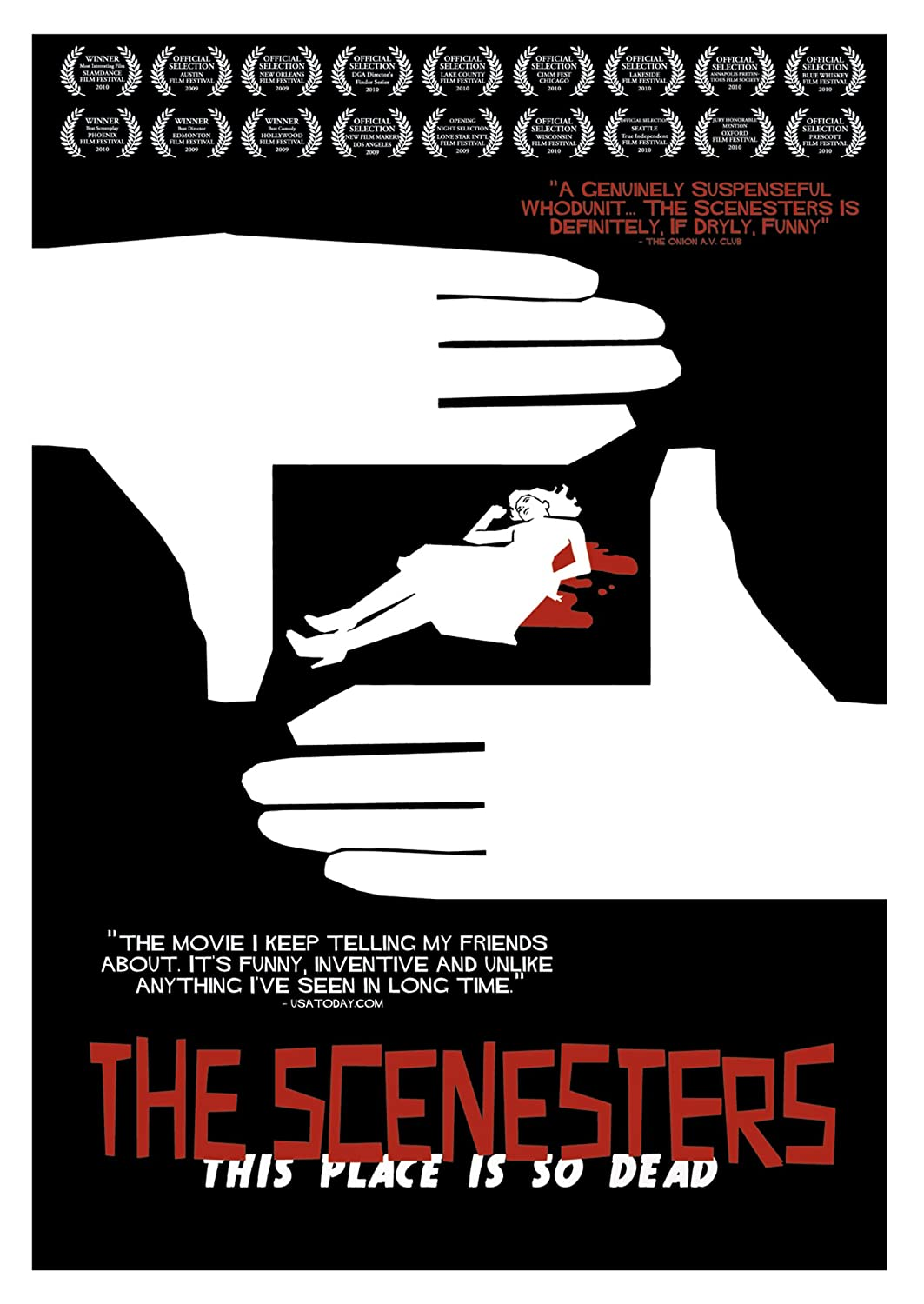
I came across a DVD of The Scenesters at the Bull Moose in Portsmouth, NH. The first thing I noticed was all the festival awards at the top of the cover, which indicated that I'd stumbled across an indie film. What's more, it seemed to be a mumble-gore movie.
I have a love-hate relationship with Mumblecore. I find that most Mumblecore movies and their respective directors are pretentious and bourgeois. The biggest offender is Joe Swanberg and his horrific nightmare is Silver Bullets (2011).
There are, however, standout directors and work. Andrew Bujalski's Computer Chess (2013) is one of my all-time favorite movies. Sometimes, the limitations that come with Mumblecore lead to intoxicating and provocative work.
It's always fun to come across something that might be considered "mumblecore," and to roll the dice. You'll either get a Computer Chess, or you'll get a Silver Bullets.
As it turns out, The Scenesters is neither. It is, in fact, the anti-mumblecore masterpiece.
The film opens up on a trailer for a fictional mumblecore movie, directed by the in-movie character Wallace Cotton. The fictional movie is apparently two hours long and features three random white people talking about nonsense in a backyard. I actually said "Jesus Christ," thinking that it was real when the film opened. Truly, it's the perfect parody of mumblecore movies.
Such an opening sets the stage for a brilliant satire of the early-2000s indie filmmaker scene.
Essentially, Wallace Cotton has been cut off financially from his dad, so he needs to start working. He starts as a freelance crime scene videographer. Meanwhile, a serial killer is on the loose, and the only one who realizes it is a crime scene janitor.
Basically, Cotton and his producer convince the janitor not to go to the police because they want to make a documentary about it. The film cuts between a courtroom, the noir-style documentary, and behind-the-scenes footage of Cotton shot by unpaid interns.
What I find so interesting about this movie is the decision to make the in-universe documentary in the style of a noir film. Both the lighting and dialogue of this mockumentary are hyper-stylized. Such stylization directly contrasts the improvisational realism of a mumblecore movie.
Essentially, The Scenesters uses genre to critique a film movement. It utilizes mumblecore tropes (i.e. improvised dialogue, poor shot framing, and arbitrary quick zooms) to parody the genre itself; while also using noir (i.e. the inverse of mumblecore) to further elaborate on its critique.
Its critique posits that filmmakers cannot claim realism while placing people within a fictional context. Both Cotton and his producer severely alter the life of the janitor in order to produce a hyper-stylized documentary, which borders on plain fiction.
The critique extends to mumblecore filmmakers, who attempt to create something "real" by using fiction. The Scenesters declare that such a thing simply cannot exist. This is, I think, why the film uses such contrasting styles -- to establish the "real" and the "fictional," and to say that the two cannot exist in the same space.
Also, it generally points out how pretentious mumblecore filmmakers are, and how incestuous their scene is. I love it.
In the end, the janitor shatters the facade. He decides that he will not be a character in a film, but a person with autonomy. He decides, ultimately, to break from the filmmakers' direction. Thus, the weak adhesive that glued the real world and the fictional world is melted away.
Unfortunately, The Scenesters is seldom talked about. It only has 127 views on Letterboxd, and most of its reviews are either lukewarm or flat-out negative.
I'd really like it if The Scenesters got more attention because it's the perfect time capsule of 2000s indie movies. It's also one of those movies that's works because it prompts you to think about it later. Not like 2001: A Space Odessey or Eraserhead, where you're prompted to decode the movie later, but more like Hellraiser or Repo Man. The events that take place in the movie are clear, but you're prompted to think about the movie's form, and how it uses its form to critique the real world.
Obviously, this is an insanely pretentious blog post, but I just love this movie, and I want to share it with anyone who's listening!